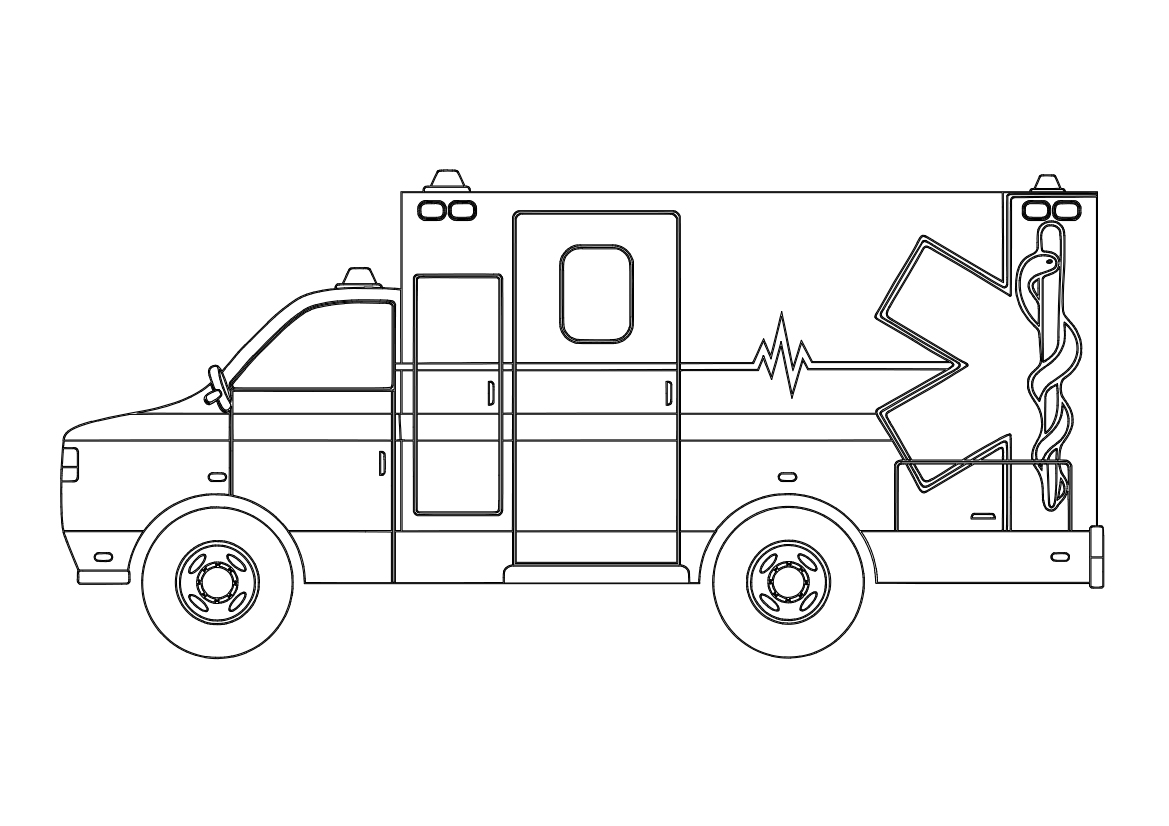
Free Ambulance Elevation CAD Block – DWG, DXF, PDF Format
An ambulance is a medically equipped vehicle which transports patients to treatment facilities, such as hospitals. Typically, out-of-hospital medical care is provided to the patient.
Ambulances are used to respond to medical emergencies by emergency medical services. For this purpose, they are generally equipped with flashing warning lights and sirens. They can rapidly transport paramedics and other first responders to the scene, carry equipment for administering emergency care and transport patients to hospital or other definitive care. Most ambulances use a design based on vans or pick-up trucks. Others take the form of motorcycles, cars, buses, aircraft and boats.
Generally, vehicles count as an ambulance if they can transport patients. However, it varies by jurisdiction as to whether a non-emergency patient transport vehicle (also called an ambulette) is counted as an ambulance. These vehicles are not usually (although there are exceptions) equipped with life-support equipment, and are usually crewed by staff with fewer qualifications than the crew of emergency ambulances. Conversely, EMS agencies may also have emergency response vehicles that cannot transport patients. These are known by names such as nontransporting EMS vehicles, fly-cars or response vehicles.
The term ambulance comes from the Latin word "ambulare" as meaning "to walk or move about" which is a reference to early medical care where patients were moved by lifting or wheeling. The word originally meant a moving hospital, which follows an army in its movements. Ambulances (Ambulancias in Spanish) were first used for emergency transport in 1487 by the Spanish forces during the siege of Málaga by the Catholic Monarchs against the Emirate of Granada. During the American Civil War vehicles for conveying the wounded off the field of battle were called ambulance wagons. Field hospitals were still called ambulances during the Franco-Prussian War of 1870 and in the Serbo-Turkish war of 1876 even though the wagons were first referred to as ambulances about 1854 during the Crimean War.
You need more Transportation and Vehicle DWG and AutoCAD Blocks and Drawings? Check the Transportation Category. Access our entire CAD blocks and DWG drawings on our homepage. For free 3D files, visit Freepolygon. Need free vector illustrations? Check out Vectorfreefiles. Stay updated with the latest design news and insights at Designrecap. Explore a global directory of design professionals and firms at Meshegg. Explore more resources for architecture students and professionals at Archiskills.
REQUEST A FILE FOR FREE
SIMILAR KEYWORDS



FAQ
-
01.
HOW CAN I EARN MONEY BY UPLOADING MY CAD FILES TO FREECADS?
You can earn ad revenue from your uploaded models. Every file you upload gets its own page with ads, and you receive an 80% share of the revenue generated from that page. The more people view your work, the more you earn.
-
02.
WHEN AND HOW ARE PAYMENTS MADE TO CREATORS?
Earnings are updated daily and paid every month using the industry standard net 40 system. That means revenue generated in one month is paid 40 days later, directly to your PayPal account.
-
03.
WHAT TYPES OF FILES CAN I UPLOAD OR DOWNLOAD ON FREECADS?
Freecads supports a wide range of professional file formats including DWG, DXF, PDF, SKP, RVT, IFC, 3DM, STEP, STP, PLN, DGN, IGS, SLDPRT, FCSTD, IPT, PRT, CATPART, 3DXML, IMODEL, and more. You can upload and download 2D and 3D models across multiple design platforms.
-
04.
WHAT IS THE DIFFERENCE BETWEEN FREE AND PREMIUM MEMBERSHIPS?
Both Free and Premium members can upload and earn from their files. Free Members can upload up to 30 files per month and track their last 30 downloads, while Premium Members enjoy an ad free experience throughout the site, unlimited uploads, unlimited download history, and priority access to new features for €2.9 per month or €19.9 per year. Both tiers can still download an unlimited amount of files.
-
05.
WHAT IS NEW IN THE LATEST VERSION OF FREECADS?
The new Freecads introduces a redesigned interface, faster search, expanded file support, and a creator dashboard that lets you track views, downloads, and earnings in real time. It is now simpler, faster, and fairer for everyone.