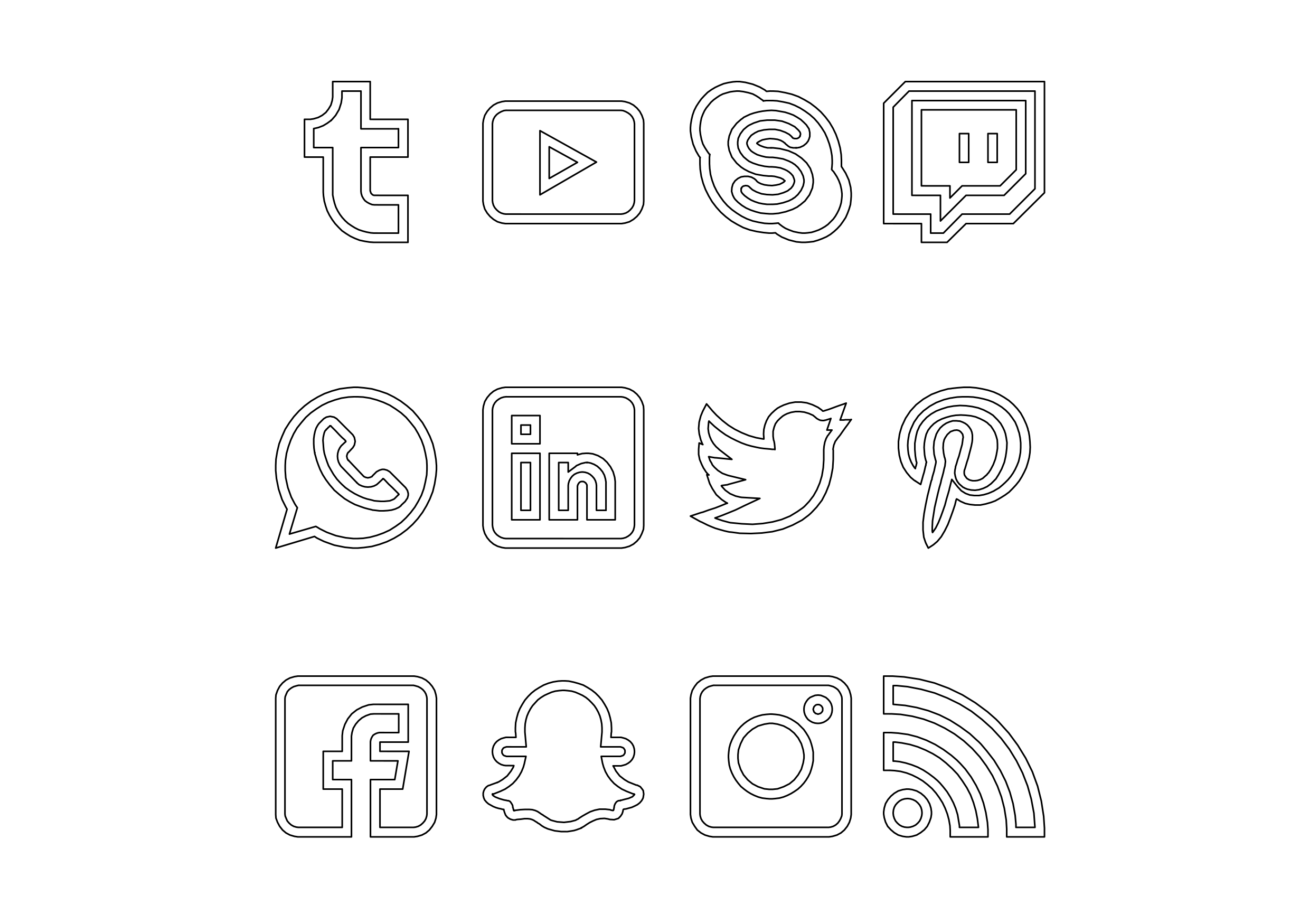
Free Social Media CAD Icons – DWG, DXF, PDF Format
Social media are interactive technologies that allow the creation or sharing/exchange of information, ideas, career interests, and other forms of expression via virtual communities and networks. While challenges to the definition of social media arise[3] due to the broad variety of stand-alone and built-in social-media services currently available, there are some common features:
Social media are interactive Web 2.0 Internet-based applications.
User-generated content—such as text posts or comments, digital photos or videos, and data generated through all online interactions—is the lifeblood of social media.
Users create service-specific profiles for the website or app that are designed and maintained by the social-media organization.
Social media helps the development of online social networks by connecting a user's profile with those of other individuals or groups.
Users usually access social media services via web-based apps on desktops and laptops, or download services that offer social media functionality to their mobile devices (e.g., smartphones and tablets). As users engage with these electronic services, they create highly interactive platforms through which individuals, communities, and organizations can share, co-create, discuss, participate, and modify user-generated content or self-curated content posted online. Additionally, social media are used to document memories; learn about and explore things; advertise oneself; and form friendships along with the growth of ideas from the creation of blogs, podcasts, videos, and gaming sites. This changing relationship between human and technology is the focus of the emerging field of technoself studies.
Some of the most popular social media websites, with over 100 million registered users, include Facebook (and its associated Facebook Messenger), TikTok, WeChat, Instagram, QZone, Weibo, Twitter, Tumblr, Baidu Tieba, and LinkedIn. Depending on interpretation, other popular platforms that are sometimes referred to as social media services include: YouTube, QQ, Quora, Telegram, WhatsApp, LINE, Snapchat, Pinterest, Viber, Reddit, Discord, VK, Microsoft Teams, and more. Wikis are examples of collaborative content creation.
Social media outlets differ from traditional media (e.g., print magazines and newspapers, and TV and radio broadcasting) in a variety of ways, including quality,[8] reach, frequency, usability, immediacy, and permanence. Additionally, social media outlets operate in a dialogic transmission system, i.e., many sources to many receivers, while traditional media outlets operate under a monologic transmission model (i.e., one source to many receivers). For instance, a newspaper is delivered to many subscribers and a radio station broadcasts the same programs to an entire city.
Since the dramatic expansion of the Internet, digital media or digital rhetoric can be used to represent or identify a culture. Studying how the rhetoric that exists in the digital environment has become a crucial new process for many scholars.
Observers have noted a wide range of positive and negative impacts of social media use. Social media can help to improve an individual's sense of connectedness with real or online communities and can be an effective communication (or marketing) tool for corporations, entrepreneurs, non-profit organizations, advocacy groups, political parties, and governments. Observers have also seen that there has been a rise in social movements using social media as a tool for communicating and organizing in times of political unrest.
You need more bundled DWG and AutoCAD Drawings? Check the Bundles Category. Access our entire CAD blocks and DWG drawings on our homepage. For free 3D files, visit Freepolygon. Need free vector illustrations? Check out Vectorfreefiles. Stay updated with the latest design news and insights at Designrecap. Explore a global directory of design professionals and firms at Meshegg. Explore more resources for architecture students and professionals at Archiskills.
DOWNLOAD FOR FREE
REQUEST A FILE FOR FREE
SIMILAR KEYWORDS
FAQ
-
01.
HOW CAN I EARN MONEY BY UPLOADING MY CAD FILES TO FREECADS?
You can earn ad revenue from your uploaded models. Every file you upload gets its own page with ads, and you receive an 80% share of the revenue generated from that page. The more people view your work, the more you earn.
-
02.
WHEN AND HOW ARE PAYMENTS MADE TO CREATORS?
Earnings are updated daily and paid every month using the industry standard net 40 system. That means revenue generated in one month is paid 40 days later, directly to your PayPal account.
-
03.
WHAT TYPES OF FILES CAN I UPLOAD OR DOWNLOAD ON FREECADS?
Freecads supports a wide range of professional file formats including DWG, DXF, PDF, SKP, RVT, IFC, 3DM, STEP, STP, PLN, DGN, IGS, SLDPRT, FCSTD, IPT, PRT, CATPART, 3DXML, IMODEL, and more. You can upload and download 2D and 3D models across multiple design platforms.
-
04.
WHAT IS THE DIFFERENCE BETWEEN FREE AND PREMIUM MEMBERSHIPS?
Both Free and Premium members can upload and earn from their files. Free Members can upload up to 30 files per month and track their last 30 downloads, while Premium Members enjoy an ad free experience throughout the site, unlimited uploads, unlimited download history, and priority access to new features for €2.9 per month or €19.9 per year. Both tiers can still download an unlimited amount of files.
-
05.
WHAT IS NEW IN THE LATEST VERSION OF FREECADS?
The new Freecads introduces a redesigned interface, faster search, expanded file support, and a creator dashboard that lets you track views, downloads, and earnings in real time. It is now simpler, faster, and fairer for everyone.